The Science
Coffee, understood.
Where it grows, what happens to it before it reaches you, and why any of that changes the taste. Move the controls; the explanations follow.
Why this page exists
Specialty coffee has a habit of holding its knowledge close. The vocabulary is real, but it is often used as a gate: know the words and you are welcome, ask a plain question and you are an amateur. We think that gets it exactly backwards. Curation is our job. We taste, we reject, we choose what is worth selling. But the understanding behind those choices is not ours to keep, and none of it is a secret. It is agronomy, chemistry and physics that anyone can follow.
So this page has no roast names, no prices and nothing to add to a bag. You should be able to read it, understand your own coffee better, and go buy someone else's. If knowing more about coffee happens to make our own work easier to judge, that is a trade we will take.
01 · The plant
Two species do almost all the work.
Over a hundred species exist in the genus Coffea. Two account for essentially everything sold, and they trade the same four things against each other in opposite directions.
Read the bars downward and the pattern is the whole story: the two are near-mirrors of each other. Everything that makes Arabica taste good also makes it hard to grow. Robusta is not a lesser plant. It is a different one, with different uses.
02 · Where it grows in India
In India, coffee grows under a canopy.
Most Indian coffee comes from the Western Ghats, farmed in a way that has no real equivalent in South America. That difference is tasteable.
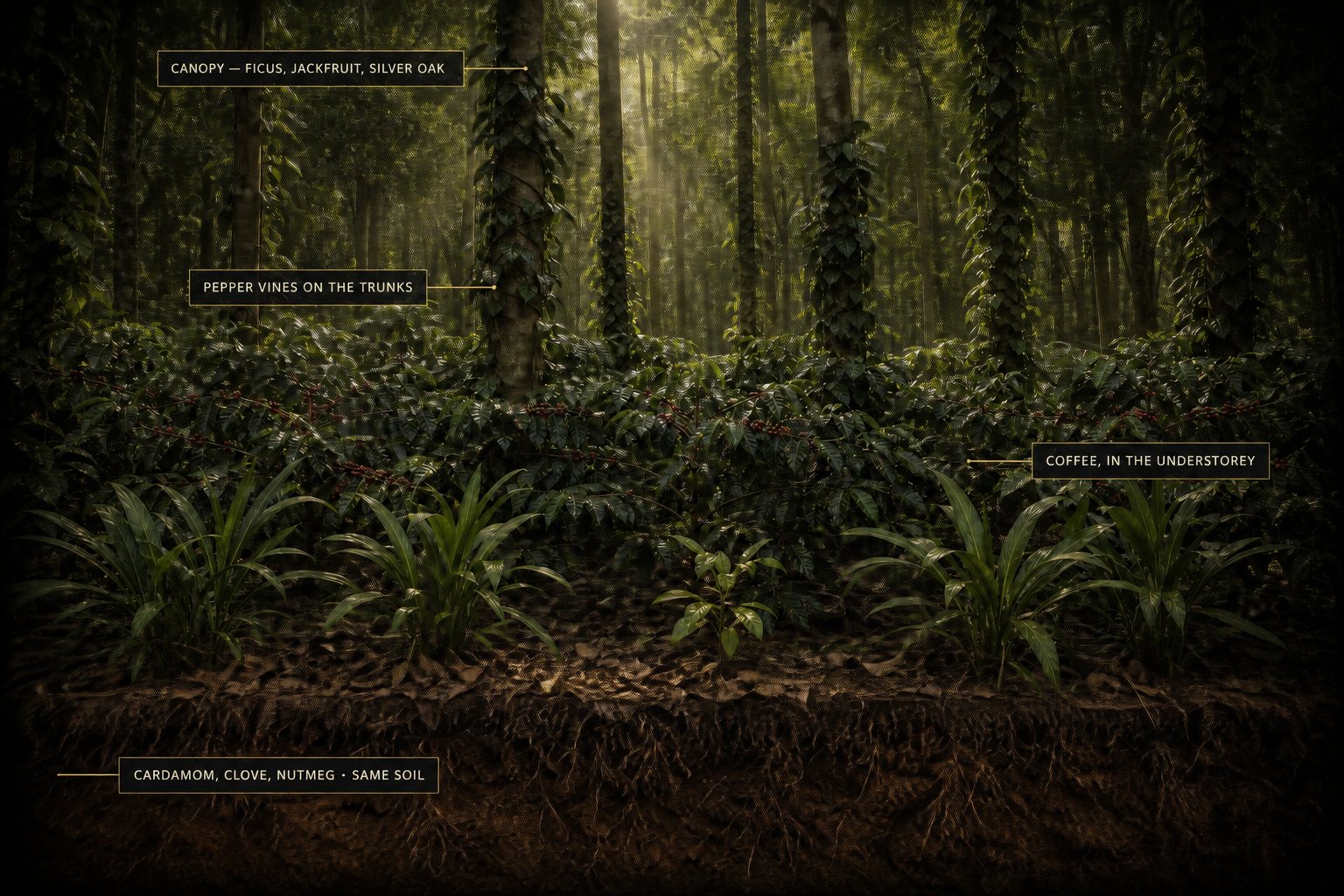
The coffee draws from ground it is sharing with spices, under filtered light rather than direct sun. This is the honest explanation for the earthiness and faint spice in Indian coffee. Not a roasting trick or an additive. What the plant grew up surrounded by.
Higher ground is cooler, and cooler air ripens the cherry more slowly. A longer ripening gives the seed more time to build sugar and acidity. Growers talk about altitude constantly because it is shorthand for how much time the fruit was given.
Indian coffee traces to Baba Budan, who by long-held account carried seven coffee seeds back from Yemen in 1670 and planted them in the hills of Chikmagalur. Those hills still carry his name.
03 · Cherry to seed
A coffee bean is a seed inside a fruit.
What gets roasted is the seed in the middle of a small red fruit. Getting one out of the other is the biggest decision made on the farm.
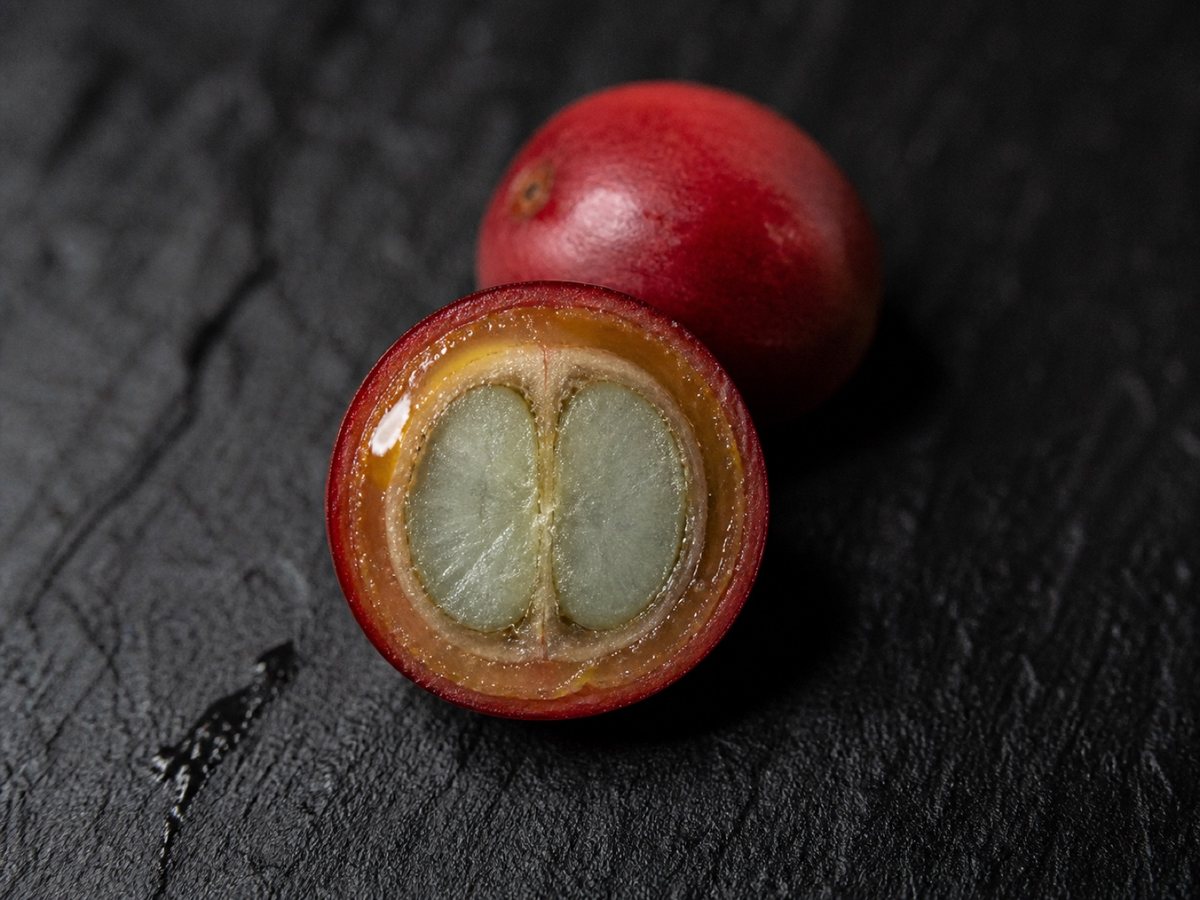
The cherryTwo seeds sit at the centre of a small stone fruit, each with one flat side where they press against the other. Everything around them has to come off.
Same hillside, same seed. The only variable is how long the seed stayed in contact with its own fruit.
04 · The roast
Ten minutes of heat make the flavour.
A green, unroasted seed smells faintly of hay. Nearly everything you recognise as the smell and taste of coffee is created by heat, in about ten minutes.
Watch the two top bars cross. Light and dark are not quality grades. They are two ends of one dial, and the roaster is choosing what to keep and what to trade away.
05 · Grades
A higher grade is a bigger seed.
The most commonly misread word in coffee. Coffee is graded by pushing it through screens with holes of a fixed diameter and counting the defects in a sample.
Between the three circles above, diameter is the only thing changing. A higher grade means bigger, more uniform, cleaner seeds, and that is all it means. It does not certify that the coffee tastes better, though uniform seeds do roast more evenly, which helps.
| Grade | Screen size | What it means |
|---|---|---|
| Plantation AAA | 18 and above · 7.1mm+ | The top of the Indian washed Arabica screen ladder, and the scarcest |
| Plantation AA | 17 and above · 6.7mm+ | Large and uniform; the grade most often exported |
| Plantation A | 16 and above · 6.3mm+ | Slightly smaller, still a high export grade |
| Plantation B | 15 and above · 6.0mm+ | Smaller again |
“Plantation” is simply the Indian trade word for washed Arabica. It is not a brand or a place.
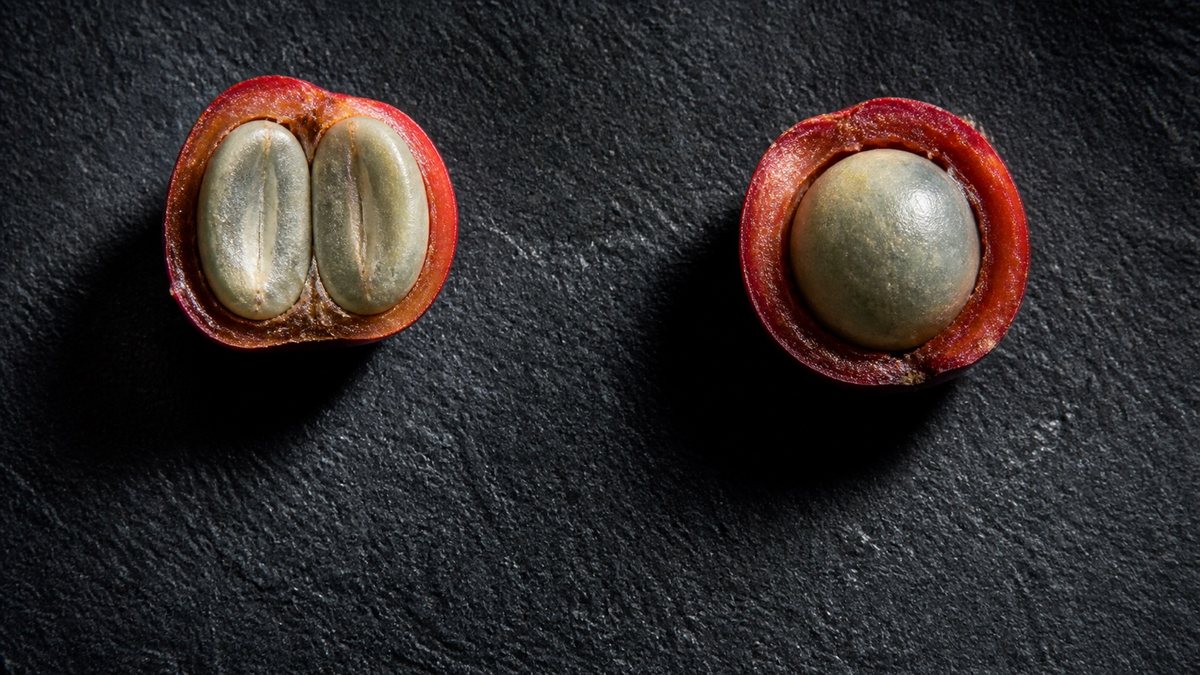
Occasionally only one seed forms, and it grows round instead. That is a peaberry. It happens in roughly five to ten percent of any crop, has to be sorted out by hand or machine, and is graded as its own category rather than by screen size.
06 · The grind
Break it smaller and the water works faster.
Water can only pull flavour from surfaces it touches. Breaking a seed into pieces is how you give it those surfaces, and how far you break it decides how fast everything happens.
Halve the particle size and you roughly double the surface the water can reach. That is why grind is not a gentle adjustment, and why it is the first thing to change when a brew tastes wrong.
So far the grind has been one number on a dial. A real grinder produces a spread instead, and how tight that spread is depends on the machine.
The blade sample's dust over-extracts and turns bitter while its boulders under-extract and stay sour, in the same cup at the same time. No brewing adjustment fixes both at once. That is why a burr grinder is the single upgrade that changes a home brew most.
That is the why. The next part is the how: ratios, water temperature, timing, and which method suits which cup.
Go to the Brew Guide →07 · Further reading
Don’t take our word for it.
Everything above is standard, checkable coffee science, not house opinion. If any of it made you want to go deeper, these are the places we would send you. They are independent of us, and mostly free.
-
Standards & research
The body behind the cupping protocol, the brewing control chart and the water standard. Its research and standards pages are where the numbers in most coffee writing originally come from.
-
Indian coffee, official
The statutory source for the grade ladder in section 05, the GI regions, and India’s production and export data. Dry reading, but it is the primary document.
-
The plant itself
World Coffee Research — Varieties Catalog
Variety-by-variety agronomy: yield, disease resistance, altitude, cup potential. The clearest free answer to “why is Arabica so difficult?”
-
The chemistry, in depth
The Craft and Science of Coffee — ed. Britta Folmer
Academic Press, 2017. A peer-reviewed survey running from soil to cup. The single best book if you want the roast chemistry in section 04 properly, with citations.
-
Roasting, practical
The Coffee Roaster’s Companion — Scott Rao
Short, opinionated and widely used in the trade. Where our framing of first crack as the landmark, and development time as the real decision, comes from.
-
Extraction & grind
Working through particle size distribution, extraction yield and why a blade grinder cannot be brewed around. Much of it is free and unusually well evidenced.